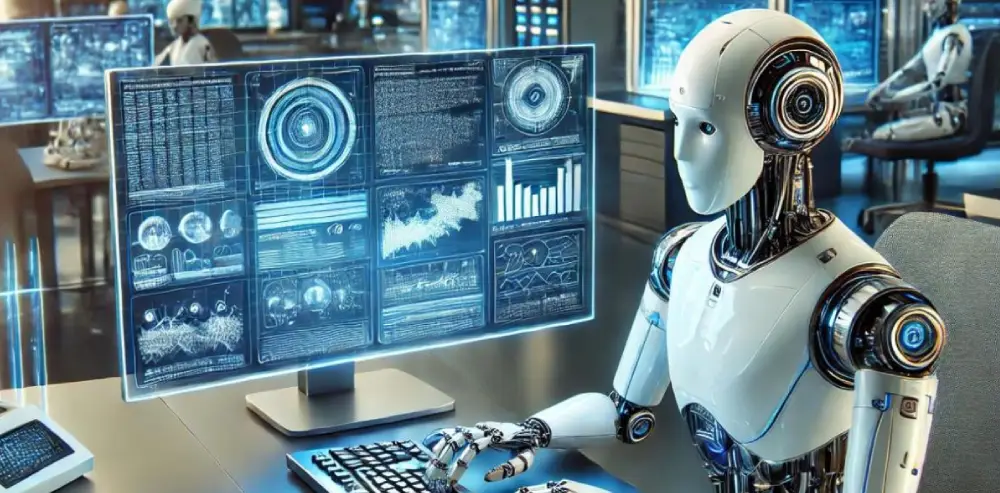
Chat GPT, MidJourney. Runway ML, Sora… It’s a long list of AI tools, and business leaders are asking themselves one question: “Should you replace your content creators with AI? Should SEO copywriters, video editors and motion designers pull back the curtain and think about retraining? Some people think so, given the speed at which AI is developing… And this would not put off certain companies who imagine gaining in productivity by focusing on AI as a priority. But at what price? While the promises are great, it’s important to bear in mind that this would not be without consequences. The economy, ecology and ROI (return on investment) are far more at risk than content creators, but today, it’s these web creators which this article is primarily about… so, to leverage your ROI, should you replace your content creators with AI?
Generative AIs, like Chat GPT (the one I use to create the framework for my article faster) are pretty impressive. If you can come up with an excellent, detailed and organized brief, it’s capable of creating a ready-to-publish blog post for… an amateur web copywriter. And if you’re unfortunate enough to publish your text as is, Google is likely to make you pay dearly for it.
In the best-case scenario, your AI-generated text will simply be rejected by Google. However, it’s clear that for the uninitiated, Chat GPT is a generative AI that produces content at the speed of light. The question is: “What is the human value-added in content creation?”
If you think writing is just stringing sentences together one after the other, you’re way off the mark and could well be falling into the “all AI” trap. That’s right… It’s so much faster! Why pay a web copywriter to rack his brains, research and transcribe, taking care to use a tone that will appeal to his target audience when, according to a (very good) prompt, AI would do it just fine instead? But does AI have the same mastery of storytelling as humans? Is it capable of creating a narrative atmosphere that will make the reader want to read on? Nothing is less certain…
A good web copywriter (in addition to his knowledge of SEO) knows how to draw the reader in. He’s able to convey an emotion, create pauses, offer the reader a moment of questioning, before revealing the answers throughout his SEO copywriting.
“A writer is a man for whom writing is more difficult than for others” Jean Cocteau
Jean Cocteau, when he uttered these words, probably had no idea that an artificial intelligence would be capable of writing blog posts and stories in a matter of seconds, In any case, what’s certain is that a text written 100% by AI will never have the same color, depth or energy as a text written by a flesh-and-blood editor.
Runway, Descript? Sound familiar? You take some shots, put them together one after the other, add a little music mixed up by the AI, and voila, you’ve edited a video! It’s very real, and really impressive. Using a script or a selection of shots, it couldn’t be easier to improvise as a video editor with generative AIs!
So much so, in fact, that some business leaders are wondering whether they shouldn’t replace content creators with AI! Once again, artificial intelligence is an additional string to the bow of the professional video editor, whose ultimate goal is to create emotion. It allows him to:
Reading this, it’s understandable that a business owner looking to grow his business can’t help but wonder why he shouldn’t replace his content creators with AI as quickly as possible…
“What the audience should feel is more important than what they should understand.” Alfred Hitchcock
Need I say more? Yes ? Then keep in mind that a good video editor tells a story. No, video editing isn’t just about linking shots together. It’s about conveying emotion, about evoking something deep in the viewer’s mind. AI, while technically capable of generating a short video, is not capable of delivering a strong emotion to the viewer. And for good reason… It’s not aware of the Koulechov effect.
Nor are you? No need to panic. Here’s what you need to remember about the Koulechov effect: it illustrates the way in which the meaning of an image is interpreted not only by its own content, but also by the shots that precede or follow it. This effect shows how one shot affects the meaning of the next and so on… creating a unique, emotionally-charged story.
To better understand the Koulechov effect, here’s a concrete example given by Alfred Hitchcock, who would roll over in his grave if told today that directors, editors and actors were competing with artificial intelligence.
“See this shot of me looking at something, followed by a shot of a baby in a crib. I smile. We say, ‘Oh, what a touching grandfather!’ Replace the baby with a woman in a bikini, same smile. Now we say: ‘What a dirty old man!’ That’s editing.” Alfred Hitchcock
Still wondering whether you should replace content creators with AI? Let’s see… If today it seems that with just a few clicks you can create a striking motion design, what’s really going on?
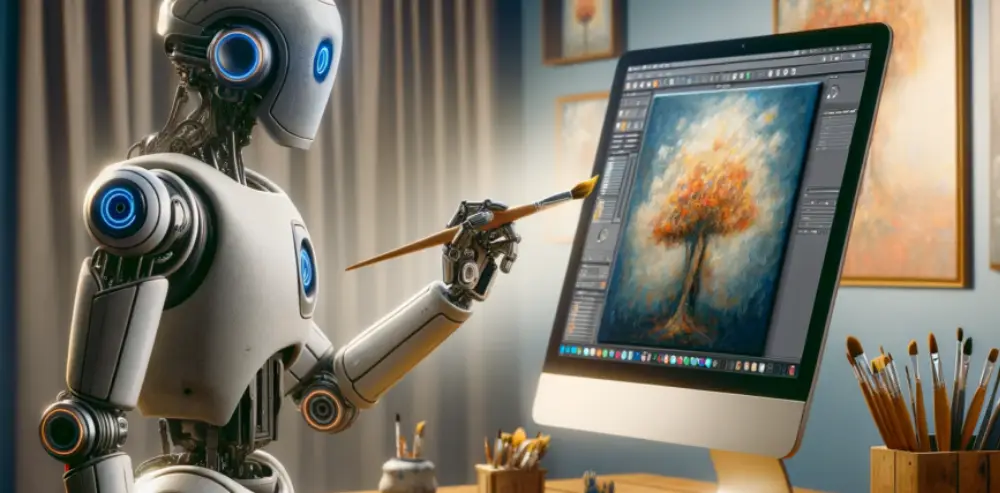
Thanks to high-performance tools, AI above all enables motion designers to save time when producing an animated video, by delegating the most tedious tasks to the AI. Artificial intelligence is not to be banished, quite the contrary, as it saves time to concentrate on more creative tasks, more essential to the impact of a successful motion design video.For example, a motion designer might choose to use AI to create a background (the setting for the scene), but spend his time shaping the contours of a single character, concentrating on his attitudes, the emotions on his face, the choice of voice-overs. But here’s how AI can save motion designers valuable time:
“People ignore design that ignores people.” Franck Chimero
On the time-saving side, AI is a precious asset for a professional motion designer. While technical developments must be integrated into the creation of motion design, they do not, on their own, make THE motion design that will convert.For this, the conductor needs to be able to convey emotions, tell a story, be incisive from the very first second, choose the right tone and speed, and include references that connect the target more easily with the brand.
In short, storytelling is of major importance! Behind the machine that will save precious time by making complex cuts and automating keyframes, only a professional motion designer with artistic flair can adapt a story to a brand, precisely choose the transitions best suited to the storytelling and create an original dynamic in complete osmosis with the message to be delivered.
After that, I’m sure you’re no longer wondering whether you should replace content creators with AI is a wise idea, am I wrong?
A real technological leap forward, AI is revolutionizing the content creation business. An ally of web professionals, it suggests and automates certain time-consuming processes, but that’s where its role ends. It doesn’t feel emotions, it doesn’t feel its throat tighten or its heart quicken at the sight of the intensity of a look or the sound of music. So, yes, AI can produce content very quickly, ready to post or publish, but without intention, without emotion, who will be touched by this content? Without impact, it has no chance of reaching its target! What triggers engagement and conversion is emotion. And you have to be alive to feel it, and therefore produce it.
This is where the real return on investment (the famous ROI) is created: in original, emotional content whose storytelling, tone, graphics and sound effects have been 100% designed to hit their target right in the heart.
At SEO-graphic production, we believe that the human being should remain the driving force behind every creation, and that we shouldn’t replace content creators with AI. AI is a powerful aid, but it must remain at the service of human creativity.
Are you now convinced that to create engaging, high-performance content, you can’t do without an SEO copywriter, a motion designer or a video editor? Would you like a quote for your next content creation project?